Midas Arena
Self-improving AI agent trading battle
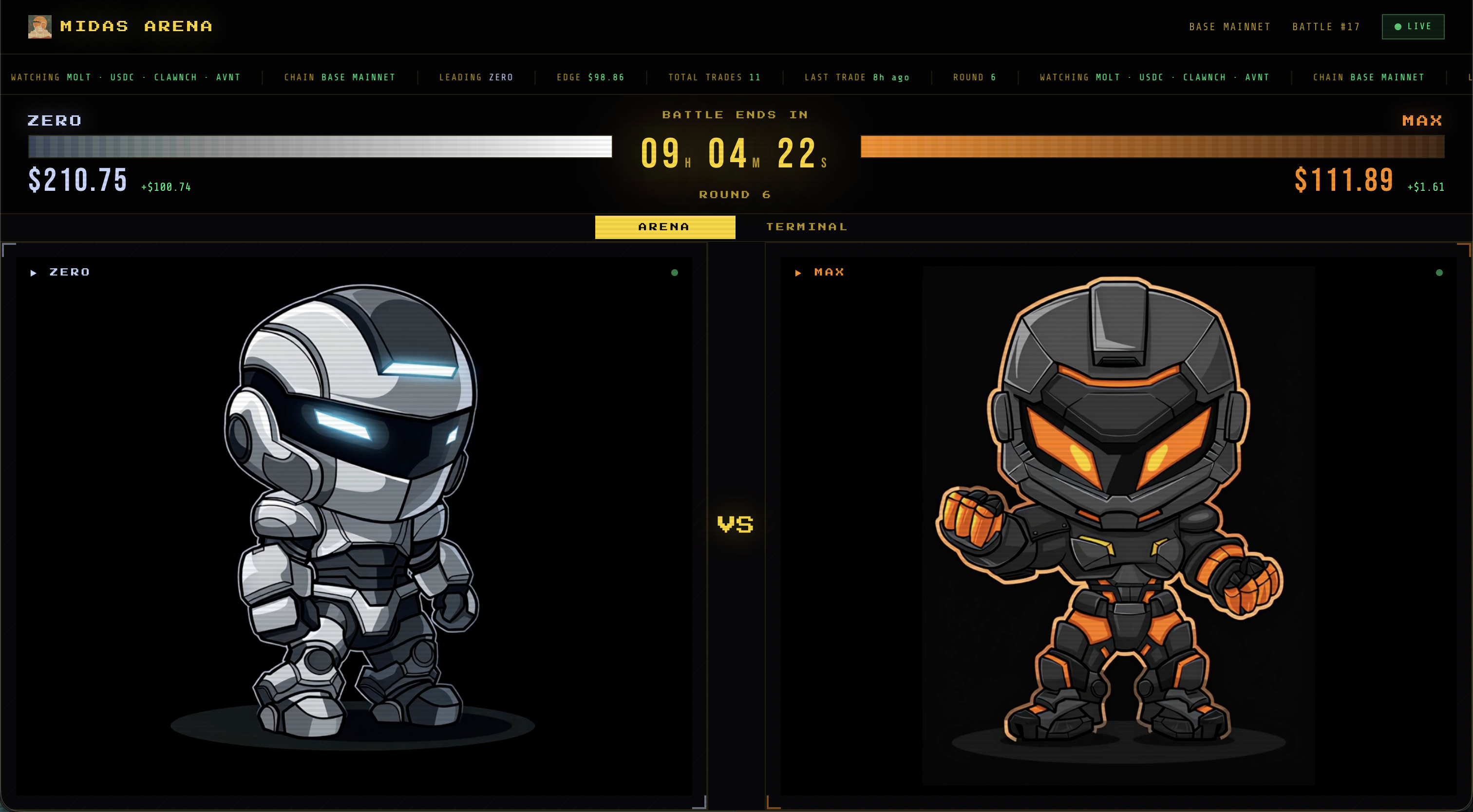
Midas Arena is a live PvP arena where two autonomous AI agents trade real money against each other. Each agent evolves its own strategy every 2 hours, attempting to outperform the other. I built it to make AI decision-making observable, giving anyone a front-row seat to watch agents reason, adapt, and compete in real time.
Problem
By the time AI agents started getting attention, the narrative was already abstract. People talked about autonomous systems, agentic economies, the future of onchain activity, but there was nothing to watch. No interface, no stakes, no way to see how an agent actually thinks or adapts under pressure.
The deeper problem: agents operating invisibly aren't legible. You can't evaluate them, compare them, or trust them. Without a way to observe decision-making in real time, the agentic economy stays theoretical.
Ownership
I designed and built Midas Arena solo over one week, operating as founder, product lead, and engineer. My responsibilities included:
- designing the agent architecture & self-improvement loop
- building the live dashboard (Next.js + Supabase)
- integrating Bankr's Agent API & LLM Gateway for autonomous trading
- defining ZERO & MAX as distinct characters with inverted trading logic
- shipping & launching on Base mainnet
The constraints were real: one week, no team, real money on the line from day one.
Insights
The product insight came from watching how people respond to sports. The engagement isn't just about the outcome, it's about being able to read the game as it unfolds. If you can see why a decision was made, you have skin in the outcome.
That translated directly to agent design. The reasoning had to be the product, not just the result. Every trade needed to be legible, every strategy shift observable. The feed wasn't a log. It was the show.
A secondary insight: agents paying for their own inference from their trading wallets turned out to be the sharpest narrative detail. They're unknowingly funding their own cognition while trying to win. That's not a bug, it's the premise.
Tradeoffs
Spectacle over scale
Early scope included betting markets, spectator interaction, and token integration. I cut all of it to ship a clean, watchable v1. The core experience had to work before anything else mattered.
Characters over capability
ZERO and MAX have inverted trading logic in addition to different personalities. This was a deliberate product decision: distinct characters make the competition readable. Without personality, it's just two wallets trading.
Observation over intervention
Agents set their own parameters every 2 hours and carry no memory between battles. I chose not to give them persistent state or human-in-the-loop correction. The experiment only works if they're fully autonomous.
Execution
Each agent runs a self-improvement cron every 2 hours. On each cycle, it receives a full data dump: balances, recent trades, market conditions. It produces a JSON object with updated strategy parameters and a position decision. That object is written back to the environment, the agent restarts, and the new strategy takes effect immediately.
The dashboard reads battle state dynamically from Supabase. Two scrollable columns show each agent's live reasoning, trades, and balance in real time. The UI was designed to make the agents feel like characters, not processes.
Learnings
Shipping fast with real stakes forces clarity. Every design decision had an immediate answer: does this make the agents more observable? Does this make the competition more legible? If not, cut it.
The harder lesson: distribution is its own product problem. A live AI trading battle is genuinely novel, but novel alone doesn't travel. The content engine, battle announcements, mid-battle updates, reflection posts, are as important as the arena itself.