Holograph App
Primary execution interface for the Holograph Protocol
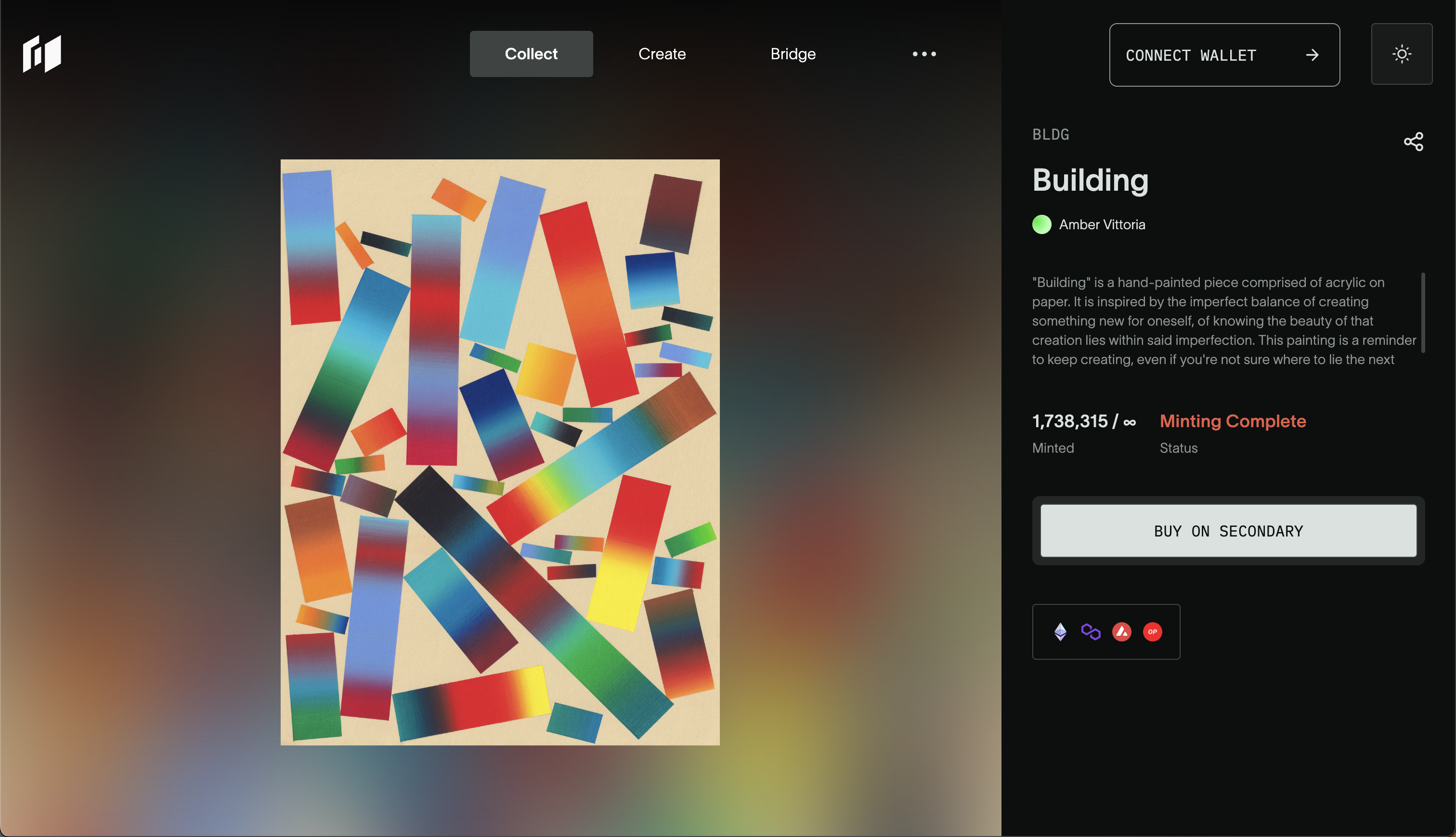
Holograph App was the primary execution interface for token issuance and cross-chain actions on top of Holograph Protocol. I led product design and iteration to improve execution clarity, reduce failure-induced drop-off, and improve user confidence as transaction volume scaled.
The app supported 11.4M mints across multiple networks under real market conditions.
Problem
As usage of the Holograph Protocol increased, a growing share of interaction flowed through the Holograph App. While the underlying system was functional, the execution experience was not yet legible to users.
Transactions could stall, fail, or complete asynchronously across chains, but the UI did not clearly reflect onchain state. Users often could not tell whether an action was still pending, had failed, or required intervention. Under load, this uncertainty led to hesitation, abandoned flows, and repeated support requests.
The problem wasn't lack of demand. It was lack of execution clarity.
Ownership
I owned product for the Holograph App end to end, including:
- execution flow design
- transaction state modeling
- failure handling and recovery UX
- instrumentation and success metrics
Key constraints shaped every decision:
- asynchronous, multi-step onchain execution
- partial failures with no single source of truth
- irreversible transactions once submitted
- users operating under time pressure and market volatility
We could not rely on happy paths. Failure had to be treated as a normal state.
Insights
Early usage data and user feedback showed consistent patterns:
- users abandoned flows after ambiguous failures
- retries dropped sharply when transaction state was unclear
- support tickets clustered around "stuck" executions
I also saw that users who experienced a failed or unclear execution were significantly less likely to attempt a second action, even when the underlying protocol eventually recovered.
The issue was not correctness, but trust in what users were seeing.
Tradeoffs
I made several deliberate tradeoffs to rebuild confidence.
Make transaction state explicit
Rather than abstracting complexity away, I surfaced clear execution states so users could understand what was happening and why.
Design for recovery, not just success
Retries, resumptions, and partial failures were treated as first-class flows instead of edge cases.
Favor clarity over polish
We deprioritized visual refinement in favor of making execution outcomes obvious and actionable, even if the interface felt utilitarian.
These choices limited short-term smoothness but improved durability and trust.
Execution
These changes directly affected user behavior and system throughput.
I redesigned core execution flows to clearly represent each step of the transaction lifecycle, including pending, failed, and recoverable states.
Automated recovery mechanisms were added for common failure modes, and the UI reflected recovery progress in real time. Instrumentation tracked first successful action, retries, and drop-off after failure.
As volume increased, I iterated based on observed failure patterns rather than theoretical UX ideals.
Impact
These changes directly affected user behavior and system throughput.
More importantly, user confidence recovered as execution became predictable and understandable, even when things went wrong.
Learnings
This work reinforced that in execution-heavy products, growth follows trust.
Users did not need systems to be perfect, but they did need to understand what was happening and what to do next. When failure modes were explicit and recovery was visible, users were far more willing to retry and continue using the product.
While Holograph Protocol guaranteed correctness, Holograph App's role was to make that correctness legible to humans.